Originally published: October 10, 2014 | Last updated: October 9, 2024
TL;DR: Writing a legally valid Canadian Will online takes about 20 minutes using LegalWills.ca. The process walks you through seven steps: entering your personal information, naming guardians for children, choosing an executor, distributing your estate, creating an alternate plan, setting up trusts for minors, and generating the final document. It costs $49.95 – no lawyer required.
The process of creating a Canadian Will through online services requires users to complete the entire procedure within 20 minutes. The process at LegalWills.ca is divided into seven clear steps. The system directs you through specific questions which it answers with simple legal term definitions while it produces a printable legal document which you can sign and have witnessed. No legal training is needed. The process becomes clear when you follow these exact steps which demonstrate how it functions.
Writing a Canadian Will online takes approximately 20 minutes from start to finish. The process at LegalWills.ca is divided into seven clear steps. You answer guided questions, receive plain-language explanations of legal terms as you go, and the system generates a province-specific legal document ready to print, sign, and witness. No legal training is needed. Here is exactly how the process works, step by step.
Step 1: Enter Your Personal and Family Information
The first step collects basic details: your full legal name, address, province of residence, marital status, and information about your spouse or partner and children. Your province determines which specific legal requirements apply to your Will; signing rules, witness requirements, and intestate succession laws all vary across Canada. This information also determines which questions the system asks next. For example, if you have minor children, you will be prompted to name guardians. If you are in a common-law relationship, the system adjusts its guidance to reflect that common-law partners have different inheritance rights than married spouses in most provinces.
The first step collects basic details: your full legal name, address, province of residence, marital status, and information about your spouse or partner and children. Your province determines which specific legal requirements apply to your Will; signing rules, witness requirements, and intestate succession laws all vary across Canada. The system uses this information to determine which questions it should ask next. The system requires you to identify guardians when you have children who are not yet adults. The system provides different advice for common-law couples because most Canadian provinces treat their inheritance rights differently from those of married couples.
If you have children under the age of majority, your Will should name a guardian, the person who will raise them if both parents die. Without this designation, a court decides who gets custody, and the outcome may not align with your wishes. You should discuss guardianship with your chosen guardian before naming them. Consider their parenting values, financial stability, location, and willingness to take on the role. You can also name an alternate guardian in case your first choice is unable or unwilling to serve. This is one of the most important decisions in any Will, and one that only a Will can address.
Step 2: Name Guardians for Your Children
Your executor is the person responsible for carrying out the instructions in your Will. Their duties include locating and securing your assets, paying outstanding debts and taxes, filing final tax returns, and distributing your estate to beneficiaries. Choose someone you trust who is organized, responsible, and willing to take on what can be a demanding role. Most people name a spouse, adult child, sibling, or close friend. You should also name an alternate executor. At LegalWills.ca, the system explains executor responsibilities in plain language so you understand exactly what you are asking someone to do.
You need to select a guardian for your minor children when you write your Will because this person will take care of them after your death. Your custody preferences become irrelevant when the court decides custody through its own decision-making process because you did not create a custody plan. You should talk to your potential guardian about guardianship matters before you officially select them for the role. The evaluation process should include their parenting principles together with their financial security and their geographic position and their readiness to accept the responsibility. You can also name an alternate guardian in case your first choice is unable or unwilling to serve. The Will contains this essential decision which only a Will document can establish.
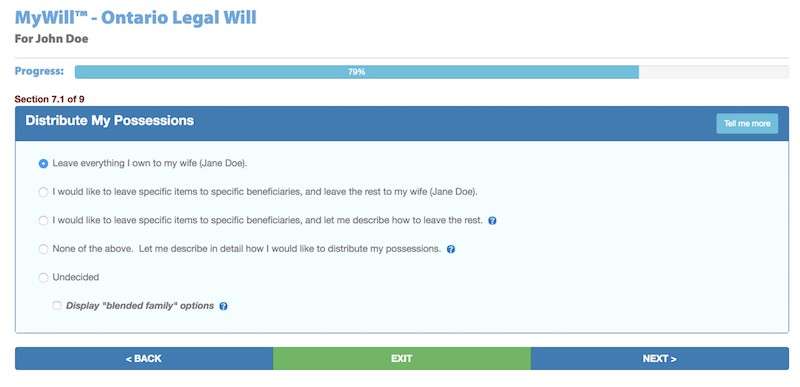
This is the core of your Will: deciding who receives what. You can distribute your estate in several ways. The simplest approach is to leave everything to one person (typically a spouse). Alternatively, you can divide your estate by percentage among multiple beneficiaries, or leave specific items or dollar amounts to named individuals or charities. LegalWills.ca lets you combine these approaches, for example, leaving specific gifts to family members and charities, with the remainder (the “residual estate”) split among your primary beneficiaries. If you want to include a charitable bequest, see our guide to planned giving in Canada.
Step 3: Choose Your Executor
What happens if your primary beneficiary dies before you do? A well-drafted Will includes an alternate distribution plan for this scenario. Without one, that portion of your estate could end up being distributed under intestate succession rules rather than your wishes. The system prompts you to name backup beneficiaries for each gift, so there is always a clear plan regardless of what happens. This “future-proofing” is one of the advantages of using a guided service, it ensures you do not overlook critical contingencies that many people miss when drafting a Will on their own.
You must designate an executor who will follow all instructions which you included in your Will document. The person who performs these duties must find your assets and protect them while they work to pay off your debts and taxes before they complete your final tax documents and distribute your assets to those who receive your estate. Select a person you trust who shows organizational skills and responsibility and who accepts the challenges which come with this position. Most people name a spouse, adult child, sibling, or close friend. You need to select a secondary executor who will handle your responsibilities. The system at LegalWills.ca explains executor duties through simple terms which help you grasp the complete scope of tasks you want your chosen person to handle.
If any of your beneficiaries are minors, you should not leave assets to them directly, a child cannot legally manage an inheritance. Instead, your Will creates a trust that holds the assets until the child reaches a specified age (commonly 18 or 21). You name a trustee to manage the funds in the meantime. The trustee can use the money for the child’s education, healthcare, and living expenses. LegalWills.ca guides you through setting the trust age, naming the trustee, and defining what the funds can be used for. This protects your children’s inheritance from mismanagement.
Step 4: Distribute Your Estate
Once you have completed all the steps, LegalWills.ca generates your Will as a printable document customized for your province. The document includes all standard legal clauses, executor powers, trust provisions, and your specific distributions. You print it, sign it in the presence of two adult witnesses (who are not beneficiaries), and store it in a safe place. Your executor should know where to find it. The entire process, from starting the questionnaire to holding your completed Will, takes about 20 minutes.
The main section of your Will requires you to decide which people should receive your assets after you pass away. You have multiple options to distribute your estate through these methods. The simplest approach is to leave everything to one person (typically a spouse). You have two options to distribute your estate: either allocate percentage-based shares to different beneficiaries or designate particular items and specific monetary amounts for particular beneficiaries and charities. LegalWills.ca enables users to combine different approaches for their estate planning needs. Users can select particular gifts for family members and charitable organizations while their main beneficiaries receive the remaining estate value. Our guide to planned giving in Canada will help you through the process of including charitable donations in your will.
After completing your Will, take these important next steps:
- Sign and witness properly: Follow your province’s specific signing requirements. Most provinces require two adult witnesses who are not beneficiaries.
- Store it safely: Keep the original in a fireproof safe, safety deposit box, or with a trusted person. Tell your executor where it is.
- Consider registering it: Some provinces offer Will registries. Learn more about how to register a Will.
- Complete your estate plan: A Will is one of three essential documents. Also prepare a Power of Attorney and Living Will.
- Review regularly: Update your Will after major life events like marriage, divorce, births, or significant asset changes.

Tim Hewson is one of the founders of LegalWills.ca.
He has over 20 years of experience helping people to write their Will and other estate planning documents. He has been interviewed by many of the major news media outlets including CTV, Global News, The Toronto Star, and other leading Canadian publications. He has also contributed to a number of financial planning books.
Throughout his career, Tim has written extensively on the subject of Will writing and estate planning.