TL;DR
A holographic Will functions as a handwritten document which eliminates the need for witness signatures. The provinces of Ontario, Alberta, Saskatchewan, Manitoba, New Brunswick, and Québec recognize this legal document. A holographic Will serves as a better option than no Will at all but it creates major legal problems because its unclear content makes probate difficult and people miss out on expert advice. People should select online Will service or lawyer assistance to create their documents because this approach leads to superior results.
Originally published: May 18, 2022 | Last updated: February 4, 2026
What Is a Holographic Will?
A holographic Will is a Last Will and Testament that is entirely handwritten, dated, and signed by the person making the Will (the testator). The defining characteristic of a holographic Will is that no witnesses are required for it to be legally valid; provided the entire document is in the testator’s own handwriting.
The word “holographic” comes from the Greek words “holos” (whole) and “graphos” (written), meaning “wholly written by hand.” It has nothing to do with holograms or modern technology.
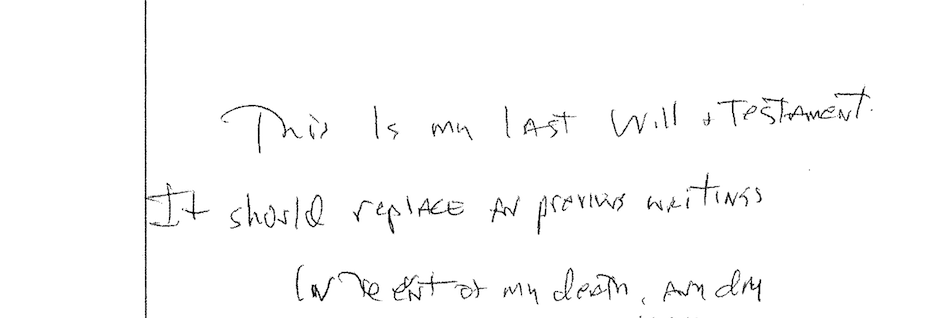
The legal system has supported Holographic Wills since ancient times. The Canadian court system established a new legal precedent through the tragic death of Cecil George Harris who became stuck beneath his tractor in Saskatchewan during 1948. He used his pocketknife to scratch “In case I die in this mess, I leave all to the wife” into the tractor’s fender. The court accepted the fender as a valid holographic Will.
Which Canadian Provinces Recognize Holographic Wills?
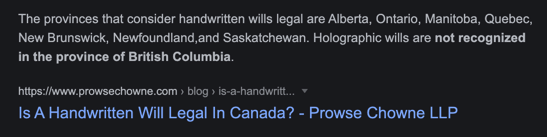
The acceptance of holographic Wills differs between Canadian provinces. Here is the current status across Canada:
| Province/Territory | Holographic Will Accepted? |
|---|---|
| Ontario | Yes |
| Alberta | Yes |
| Saskatchewan | Yes |
| Manitoba | Yes |
| New Brunswick | Yes |
| Québec | Yes |
| British Columbia | No (but courts may validate under s.58 WESA) |
| Nova Scotia | No |
| Prince Edward Island | No |
| Newfoundland & Labrador | No |
| Northwest Territories | No |
| Yukon | No |
| Nunavut | No |
The law requires typed or printed Wills to receive testator signatures and two independent witnesses who must not become beneficiaries in provinces which do not accept holographic Wills. Our guide on signing your Will in Canada provides information about the specific requirements for signing a Will.
What Are the Requirements for a Valid Holographic Will?
The provinces which accept holographic Wills require these specific elements for them to achieve legal validity:
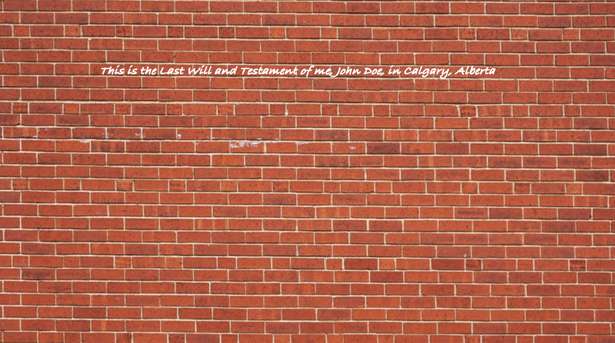
- The testator needs to write every single word of the document by hand. The document must remain free from any typed or printed or pre-printed elements. The Will becomes invalid when it contains even one printed line.
- The testator must provide their signature at the end of the document to complete the process of signing the document.
- The Will requires dating although this practice does not always qualify as a legal obligation because it helps determine which Will holds the most recent date when multiple Wills exist.
- The document needs to show a clear intention about how the property should distribute after death.
The holographic Will creates a dangerous situation for people who want to protect their property rights.
The legal value of a holographic Will exists in certain provinces yet it creates multiple dangers which surpass the security offered by a professionally drafted Will:
- People who write Wills without legal help tend to create unclear statements which become difficult to understand because they lack legal direction. The statement “I leave everything to my family” creates problems because people cannot decide which relatives belong in the term “family.”
- The text of Holographic Wills often fails to include vital sections which should contain alternative beneficiary information and Executor appointment details and instructions for handling remaining estate assets and instructions for child guardianship.
- The legal system faces challenges when it comes to disputing Holographic Wills because these documents often face court battles regarding forced influence and mental competence and signature authenticity issues.
- The probate process requires courts to use handwriting analysis and additional evidence to establish document authenticity which leads to longer time frames and higher expenses.
- The creation of a handwritten Will fails to benefit from professional legal counsel which online Will services provide to verify all legal requirements.

When Might a Holographic Will Be Appropriate?
A holographic Will should be considered only as a temporary or emergency measure in situations such as:
- Medical emergency, If you are facing an imminent health crisis and cannot access legal services
- Remote location, People who live in places without witnesses need to use online Will services which become available to anyone who has internet access.
- Immediate need, The document serves as a temporary solution which will become obsolete when you obtain a properly witnessed Will.
The process of replacing an emergency holographic Will with a formal Will needs to occur as soon as possible. You can create a proper Will through an online Will service which takes only minutes while providing superior legal protection.
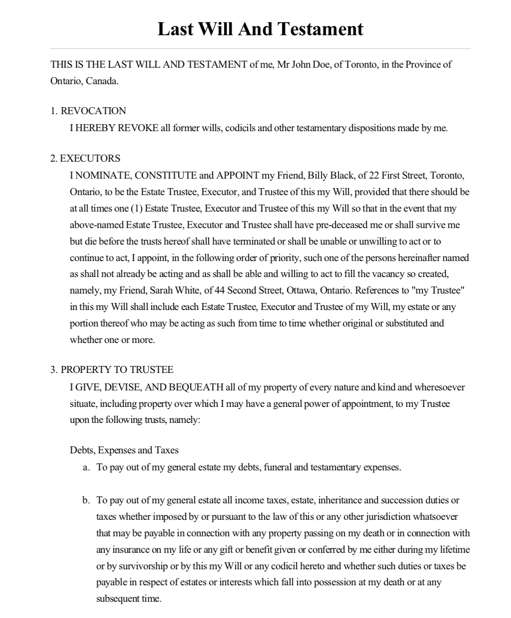
Better Alternatives to a Holographic Will
The majority of Canadian citizens should select better alternatives instead of creating a handwritten holographic Will:
| Option | Cost | Advantages |
|---|---|---|
| Online Will Service | $49.95–$99.95 | The service provides a guided process which follows provincial rules and allows users to update their documents without any limitations while producing legally binding results. |
| Estate Planning Lawyer | $500–$3,000+ | The lawyer offers customized guidance while managing all aspects of property distribution for complicated inheritance cases. |
| Holographic Will | Free | The document exists without cost but it creates major legal problems which provide no protection to the person who made it. |
For a comprehensive comparison of all your options and their costs, see our guide on the cost of a Will in Canada.

Frequently Asked Questions
Can I write my Will on a napkin?
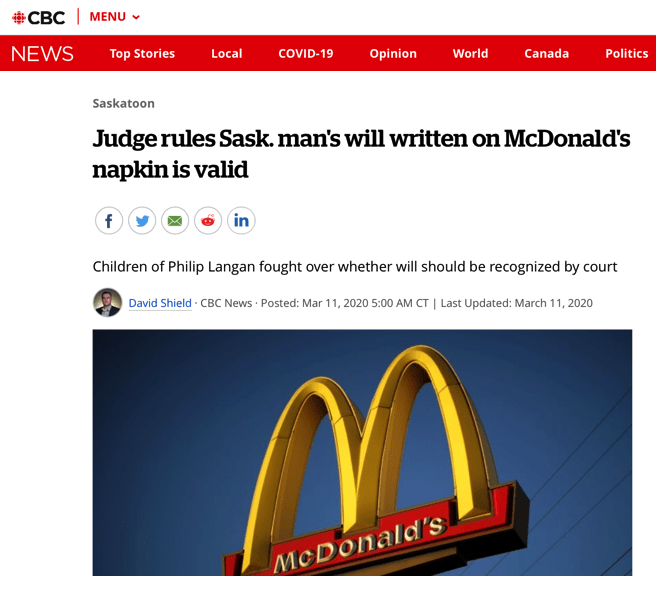
The law allows holographic Wills in provinces which accept them so you can write your Will anywhere as long as you handwrite the entire document and sign it while showing your intention to create a Will. However, a napkin Will is extremely risky and should only be considered in a life-threatening emergency.
Does a holographic Will need to be notarized?
No. The law does not require holographic Wills to receive notarization or witness signatures. However, in Québec, a notarial Will (prepared by a notary) is a separate and distinct type of Will with its own advantages. Learn more about Wills in Québec.
Can I type part of my holographic Will?
No. A holographic Will must be entirely in the testator’s handwriting. The entire document becomes invalid when it contains any typed or printed or pre-printed text.
How do I revoke a holographic Will?
The same procedures which apply to other Wills also apply to holographic Wills during the revocation process. You can create a new Will which contains a revocation clause to replace your existing Will. The document becomes invalid when you destroy it with the purpose of revoking it. Most provinces require marriage to automatically cancel any Will which existed before the wedding. The guide about Will modifications provides additional information about this subject.


Tim Hewson is one of the founders of LegalWills.ca.
He has over 20 years of experience helping people to write their Will and other estate planning documents. He has been interviewed by many of the major news media outlets including CTV, Global News, The Toronto Star, and other leading Canadian publications. He has also contributed to a number of financial planning books.
Throughout his career, Tim has written extensively on the subject of Will writing and estate planning.