Originally published: March 20, 2015 | Last updated: November 20, 2024
TL;DR: There are three ways to update a Will in Canada: handwriting changes on the document (risky and not recommended), adding a codicil (a formal amendment), or creating an entirely new Will. The best approach for most people is to create a new Will – especially with an online service like LegalWills.ca where you simply log in, make changes, and print a new version.
You should update your Will whenever life events such as marriage or divorce or birth of a child or death of someone or acquisition of new property or relocation between Canadian provinces occur. The process to change a signed legal document which has already received witness signatures remains unclear to me. People can choose from three different options which Canada offers for risk assessment and operational usefulness.
Life changes, marriages, divorces, births, deaths, new assets, moves between provinces, all create reasons to update your Will. But how exactly do you make changes to a legal document that has already been signed and witnessed? There are three options available in Canada, each with different levels of risk and practicality.
Option 1: Handwrite Changes on the Will
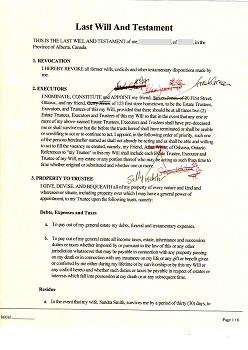
Not recommended. Physically writing changes on a signed Will is risky and often ineffective. In most provinces, handwritten alterations to a formal (typed) Will are not valid unless they are initialled by the testator and the original witnesses. Even then, the changes may be ambiguous or disputed. Crossing out a beneficiary’s name and writing in a new one might seem simple, but it can create grounds for contesting the Will. Courts treat altered Wills with suspicion, and handwritten changes can raise questions about when they were made and whether the testator was of sound mind at the time.
Not recommended. Physically writing changes on a signed Will is risky and often ineffective. The law requires testators to sign their handwritten Will changes before their first witnesses must also sign the document to make these changes effective in most provinces. The process of change becomes difficult to understand because different groups fight against each other. The process of replacing a beneficiary name through crossing out their original name creates legal opportunities for Will challenges. Courts maintain distrust toward modified Wills because they make judges doubt when the changes occurred and whether the person who wrote them stayed mentally stable during that period.
A codicil is a formal legal amendment to an existing Will. It must be prepared, signed, and witnessed with the same formality as the original Will. A codicil references the original Will and specifies exactly which provisions are being changed, added, or removed. This was the traditional method of updating a Will before online services existed, and it is still used by lawyers today. However, codicils have drawbacks: they add complexity (your executor must now read two documents together), they cost additional lawyer fees (typically $100 to $300 per codicil), and multiple codicils can create confusion or contradictions. For anything beyond a minor change, a new Will is usually the better option.
Option 2: Add a Codicil
The cleanest, most reliable way to update your Will is to create a new one. A properly drafted new Will includes a clause revoking all previous Wills and codicils, eliminating any confusion about which document governs your estate. With a lawyer, this means another appointment and another fee. With an online service like LegalWills.ca, it means logging into your account, updating the relevant sections, and printing a fresh document, a process that takes minutes and is included in your subscription. This is why online Will services have a fundamental advantage over traditional legal approaches when it comes to keeping your Will current.
A codicil is a formal legal amendment to an existing Will. The document requires the same level of formality during its creation process which includes signing and witnessing as the original Will received. The original Will exists as a reference point in a codicil which defines the particular sections that need modification or addition or deletion from the document. The traditional method of Will updates before online services appeared continues to be used by lawyers until today. The creation of codicils leads to three main problems because they require executors to handle two separate documents and they demand extra legal expenses which typically range from $100 to $300 per document and multiple codicils tend to produce confusing and conflicting information. The better choice between creating a new Will or making a minor update depends on the nature of the change you want to make.
As a general rule, review your Will every 3 to 5 years, and update immediately after any of these events:
- Marriage: In most provinces, marriage automatically revokes a prior Will.
- Divorce: While divorce may revoke provisions for an ex-spouse in some provinces, it does not in all; update to be safe.
- Birth or adoption: New children should be named and have guardians designated.
- Death of a beneficiary or executor: Replace with your current choice.
- Major asset changes: Buying or selling property, receiving an inheritance, starting a business.
- Moving provinces: Provincial laws differ; your Will should comply with your new jurisdiction.
- Change in wishes: If you want to add a charitable bequest or change how your estate is divided.
The easiest way to keep your Will up to date is to use a service that makes updating painless. At LegalWills.ca, your Will is always accessible, always editable, and always province-specific. To understand why having a Will matters in the first place, see Do I Need a Will? For a full walkthrough, read our step-by-step guide to writing your Will.

Tim Hewson is one of the founders of LegalWills.ca.
He has over 20 years of experience helping people to write their Will and other estate planning documents. He has been interviewed by many of the major news media outlets including CTV, Global News, The Toronto Star, and other leading Canadian publications. He has also contributed to a number of financial planning books.
Throughout his career, Tim has written extensively on the subject of Will writing and estate planning.