TL;DR
To write a legally valid Will in Ontario, you must be at least 18 years old, have testamentary capacity, and sign the Will in the presence of two witnesses who also sign. Ontario recognizes formal Wills and holographic (handwritten) Wills. The most affordable option is an online Will service like LegalWills.ca ($49.95), compared to $500–$1,500+ for a lawyer. Ontario has specific rules on marriage revocation, estate administration tax (probate fees), and the Succession Law Reform Act governs intestacy.
Originally published: October 1, 2021 | Last updated: December 10, 2025
Writing a Will in Ontario follows the rules set out in the Succession Law Reform Act (SLRA) and the Estates Act. Ontario is Canada’s most populous province, home to approximately 15 million people, yet surveys consistently show that more than half of Ontario adults do not have a Will. This guide explains exactly how to create a legally valid Will in Ontario, what it costs, and what happens if you die without one.

What Are the Legal Requirements for a Will in Ontario?
Under the Succession Law Reform Act, a valid formal Will in Ontario requires:
- Age: The testator must be at least 18 years old (exceptions for married individuals and members of the Canadian Armed Forces)
- Testamentary capacity: The testator must understand the nature of a Will, the extent of their property, and the claims of those who might expect to benefit
- Written document: The Will must be in writing (typed or printed is acceptable)
- Signature: The testator must sign at the end of the Will
- Two witnesses: Two witnesses must be present, see the testator sign (or acknowledge their signature), and then sign the Will themselves in the testator’s presence
- Voluntariness: The Will must be made freely, without undue influence or coercion
What Types of Wills Are Valid in Ontario?
| Type | Requirements | Recommended? |
|---|---|---|
| Formal Will | Written, signed by testator, signed by two witnesses | Yes, the standard and safest option |
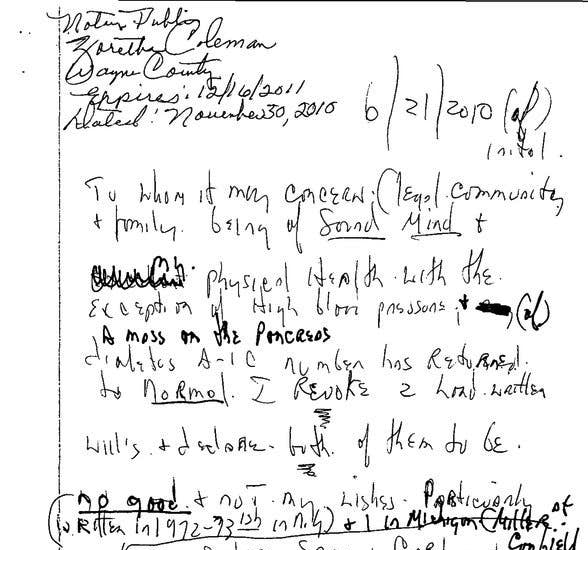
| Holographic Will | Entirely in testator’s handwriting, signed by testator, no witnesses needed | Not recommended; vulnerable to challenges |
| Electronic Will | Created and signed electronically, with virtual witnessing via audio-visual technology | Available since 2022; check current requirements |
Ontario made electronic Wills and virtual witnessing permanently available in 2022, making it one of the most progressive provinces for Will execution options.
How Much Does a Will Cost in Ontario?
| Method | Cost | Time |
|---|---|---|
| Estate planning lawyer | $500–$1,500+ | 2–4 weeks |
| Online Will (LegalWills.ca) | $49.95 | 20 minutes |
| Will kit | $15–$35 | 1–2 hours |
| Holographic (handwritten) | Free | Varies |
For most Ontario residents with straightforward estate planning needs, an online Will provides the best combination of affordability, speed, and legal validity. For a detailed comparison, see our guide to the cost of a Will in Canada.
What Are Ontario’s Specific Rules About Marriage and Wills?
Ontario has important rules about how marriage and divorce affect a Will:
- Marriage revokes a Will: In Ontario, getting married automatically revokes any existing Will, unless the Will was made “in contemplation of marriage” to a specific person. If you get married without updating your Will, you die intestate.
- Divorce does not revoke a Will: Divorce in Ontario only revokes the provisions that benefit the ex-spouse (gifts and executor appointment). The rest of the Will remains valid. However, it is strongly recommended to create a new Will after divorce.
These rules make it critical to update your Will after any change in marital status.
What Is Ontario’s Estate Administration Tax (Probate Fee)?
Ontario has the highest probate fees in Canada, officially called the Estate Administration Tax:
- $0 on the first $50,000 of estate value
- $15 per $1,000 (1.5%) on estate value above $50,000
For example, an estate valued at $500,000 would pay approximately $6,750 in Estate Administration Tax. This makes Ontario one of the most expensive provinces for probate and is a key reason why estate planning, including strategies to minimize probate exposure, is particularly important for Ontario residents.
What Happens If You Die Without a Will in Ontario?
If you die intestate in Ontario, the Succession Law Reform Act determines how your estate is distributed:
- Married, no children: Spouse receives entire estate
- Married with children: Spouse receives the first $350,000 (preferential share); remainder split equally between spouse and children
- Common-law partner: Receives nothing under Ontario intestacy law; common-law partners have no automatic inheritance rights in Ontario
- No spouse or children: Estate goes to parents, then siblings, then more distant relatives
The absence of inheritance rights for common-law partners in Ontario makes a Will absolutely essential for anyone in a common-law relationship. Learn more about dying without a Will.
How to Write a Will in Ontario: Step by Step
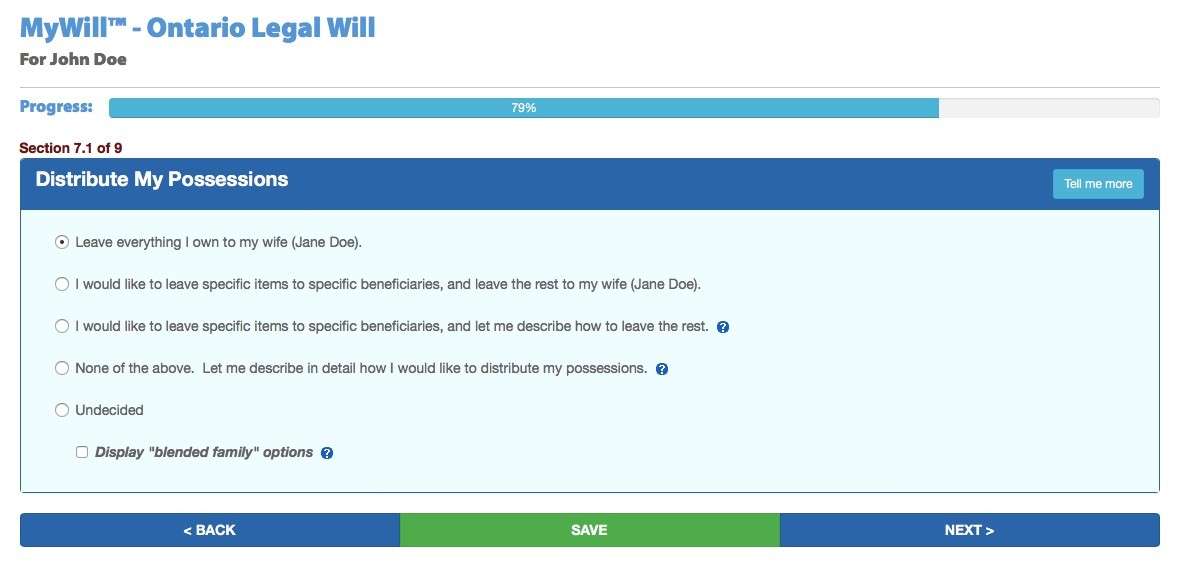
- Choose your method: Online service (LegalWills.ca), lawyer, or DIY
- Gather information: List your assets, debts, beneficiaries, and preferences
- Name your executor (called “estate trustee” in Ontario) and an alternate
- Name a guardian for minor children (if applicable)
- Specify your distribution plan: Who gets what, and what happens if a beneficiary predeceases you
- Include provisions for digital assets
- Print, sign, and witness: Follow the signing rules
- Complete the Affidavit of Execution
- Store securely and inform your executor
- Register with the Canada Will Registry
Frequently Asked Questions
Is an online Will legally valid in Ontario?
Yes. An online Will is legally valid in Ontario when properly signed and witnessed. The Succession Law Reform Act does not require a Will to be prepared by a lawyer.
Do I need a lawyer to write a Will in Ontario?
No. There is no legal requirement to use a lawyer. An online Will service like LegalWills.ca produces a legally valid Will at a fraction of the cost. A lawyer may be advisable for complex situations such as blended families or business succession.
What is an “estate trustee” in Ontario?
Ontario uses the term “estate trustee” instead of “executor.” The role is identical; administering the estate, paying debts, and distributing assets according to the Will.
Can common-law partners inherit in Ontario without a Will?
No. Ontario intestacy law does not recognize common-law partners as heirs. A Will is the only way to ensure your common-law partner inherits from your estate.
How do I reduce probate fees in Ontario?
Common strategies include: naming beneficiaries directly on registered accounts (RRSPs, TFSAs, life insurance), holding property in joint tenancy with right of survivorship, and establishing inter vivos (living) trusts. Consult a financial advisor for strategies specific to your situation.

Tim Hewson is one of the founders of LegalWills.ca.
He has over 20 years of experience helping people to write their Will and other estate planning documents. He has been interviewed by many of the major news media outlets including CTV, Global News, The Toronto Star, and other leading Canadian publications. He has also contributed to a number of financial planning books.
Throughout his career, Tim has written extensively on the subject of Will writing and estate planning.