Originally published: September 21, 2016 | Last updated: February 12, 2025
TL;DR: A guardian is the person who raises your minor children if both parents die. Only a Will can designate a guardian – without one, a court decides. Choose someone whose parenting values align with yours, who is willing and able to serve, and name an alternate. A guardian does not have to be a relative. This is one of the most important decisions in any parent’s Will.
Your Last Will and Testament lets you choose a guardian who will care for your minor children when both parents pass away. This position operates independently from the trustee who handles your children’s financial assets and from the executor who oversees your complete estate administration. The guardian must serve as the child’s permanent caretaker because they need to provide shelter and education and medical care and all aspects of child development. The court will decide on your behalf because you didn’t name a guardian in your Will but their decision might not follow your personal values and preferences.
A guardian is the person you designate in your Last Will and Testament to take physical custody of your minor children and raise them if both parents die. This is a distinct role from a trustee (who manages your children’s financial inheritance) or an executor (who manages your overall estate). The guardian becomes the child’s day-to-day parent; responsible for housing, education, healthcare, and upbringing. Without a guardian designation in your Will, a court makes this decision, and the outcome may not align with your wishes or values.

Does a Guardian Have to Be a Relative?
No. There is no legal requirement that a guardian be a family member. You can name anyone you trust, a close friend, a neighbour, a member of your religious community, or a colleague. What matters is not the biological relationship but the person’s ability and willingness to raise your children in a way that aligns with your values. Many parents find that a close friend is a better fit than a relative who lives far away, has very different parenting views, or is not in a suitable life stage to take on children.
No. The law does not require guardians to have any family relationship with the children they will care for. You can name anyone you trust, a close friend, a neighbour, a member of your religious community, or a colleague. What matters is not the biological relationship but the person’s ability and willingness to raise your children in a way that aligns with your values. Parents tend to choose close friends for child care because their relatives live too far away or they follow different parenting methods or they lack proper readiness to handle children.
Selecting a guardian requires weighing several important factors:
- Parenting values: Does this person share your views on discipline, education, religion, and lifestyle? Your children’s upbringing should be consistent with your wishes.
- Age: A guardian should be old enough to be a responsible parent but young enough to have the energy and health to raise children for years. Naming elderly grandparents may create problems if they become unable to care for active children.
- Family situation: Does the guardian already have children? A household with children of similar ages can provide companionship, but too many children may strain resources. A single person may be a perfectly suitable guardian if they have the stability and support network.
- Location: Moving children to a different city or province adds trauma to an already devastating situation. A local guardian minimizes disruption to school, friendships, and routine.
- Financial stability: While your children’s inheritance (managed by a trustee) can cover many expenses, the guardian should have a stable home environment. Financial stability does not mean wealth, it means the ability to provide a secure home.
- Willingness: Always discuss guardianship with your chosen person before naming them. Guardianship is a major commitment, and the person must agree to take it on. An unwilling guardian serves no one well.
What Should You Consider When Choosing a Guardian?
Yes, always. Your first-choice guardian may be unable or unwilling to serve when the time comes, they may have health issues, have moved abroad, or their circumstances may have changed. An alternate guardian ensures there is always a plan in place. Without an alternate, the court must decide if your primary guardian cannot serve, defeating the purpose of naming one in the first place.
You need to examine multiple essential elements before you decide to pick someone as a guardian.
Yes, and they should. As your children grow, as your relationships evolve, and as your chosen guardian’s circumstances change, your designation should be reviewed and updated in your Will. A guardian who was ideal when your children were toddlers may not be the right choice when they are teenagers. Review your guardian designation every time you review your Will; at minimum every 3 to 5 years and after any significant change in your family or the guardian’s situation.
Parenting values: Does this person share your views on discipline, education, religion, and lifestyle? Your children’s upbringing should be consistent with your wishes.
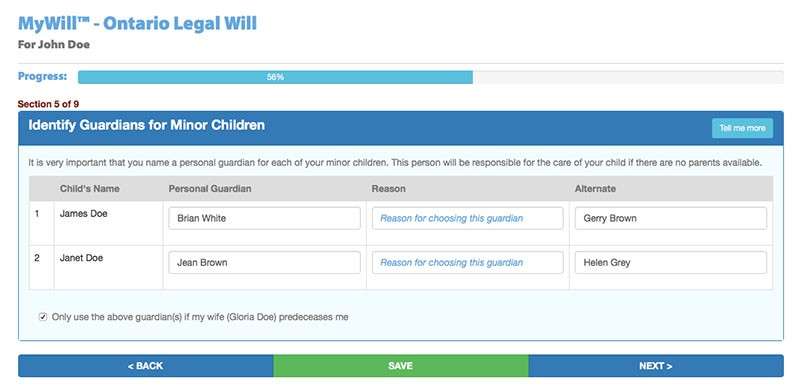
At LegalWills.ca, naming a guardian is a built-in step in the Will-writing process. If you have minor children, the system prompts you to name a guardian and an alternate guardian. You provide their full legal names and relationship to your children. The system generates the appropriate legal clauses, ensuring the designation meets provincial requirements. Combined with trust provisions for your children’s inheritance, this creates comprehensive protection for your kids. For more on trusts, see our discussion of trusts in blended family estate planning.

Tim Hewson is one of the founders of LegalWills.ca.
He has over 20 years of experience helping people to write their Will and other estate planning documents. He has been interviewed by many of the major news media outlets including CTV, Global News, The Toronto Star, and other leading Canadian publications. He has also contributed to a number of financial planning books.
Throughout his career, Tim has written extensively on the subject of Will writing and estate planning.