
TL;DR
Legal language in Wills can be confusing, but every term has a specific meaning. This glossary explains the key words you will encounter: testator, executor, beneficiary, probate, intestate, bequest, devise, guardian, trust, codicil, and more. Understanding these terms helps you make informed decisions when preparing your Will. Québec uses different terminology (liquidator, tutor) due to its Civil Code system.
Originally published: September 26, 2021 | Last updated: November 12, 2025
Legal language in Wills exists for precision, each word has a specific, well-defined meaning that has been tested and refined through centuries of case law. While this precision is valuable in a legal document, it can make Wills difficult for non-lawyers to understand. This comprehensive glossary explains every key term you will encounter when preparing your Will, written in plain language. For a related overview, see our guide to definitions for non-lawyers.
Why Is Legal Language in Wills So Complicated?
Legal language (sometimes called “legalese”) in Wills serves a specific purpose: eliminating ambiguity. In everyday English, words can have multiple meanings depending on context. In a Will, ambiguity can lead to expensive court disputes, unintended consequences, and family conflict. Legal terms provide:
- Precision: Each term has a single, well-established legal meaning
- Consistency: Courts interpret these terms the same way across cases
- Completeness: Legal phrases often incorporate centuries of case law into a few words
Modern Will-writing services like LegalWills.ca use plain language where possible while maintaining the legal precision necessary for the document to be enforceable.
What Is a Testator?
A testator is the person who makes the Will. If you are writing your Will, you are the testator. The term comes from the Latin “testari” meaning “to bear witness” or “to make a will.” The feminine form “testatrix” exists but is increasingly rare in modern Canadian legal practice. “testator” is used for all genders.
To be a valid testator in Canada, you must:
- Be at least 18 years old (19 in some provinces)
- Have testamentary capacity (sound mind)
- Act voluntarily, without undue influence
What Is Your Estate?
Your estate is everything you own at the time of your death, minus everything you owe. It includes:
| Assets (What You Own) | Liabilities (What You Owe) |
|---|---|
| Real estate (house, condo, land) | Mortgage |
| Bank accounts and savings | Credit card debt |
| Investments (stocks, bonds, mutual funds) | Loans (car, student, personal) |
| Vehicles | Outstanding taxes |
| Personal belongings (jewellery, art, furniture) | Unpaid bills |
| Digital assets | Business debts |
Note: Some assets pass outside of the Will; life insurance with a named beneficiary, jointly held property with right of survivorship, and registered accounts (RRSPs, TFSAs, RRIFs) with a named beneficiary. Learn more about what happens to your debt when you die.
What Is an Executor?
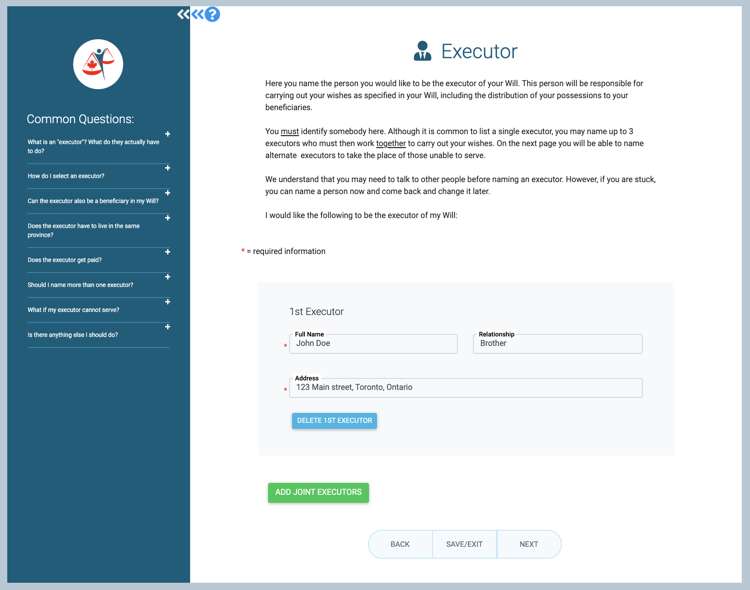
An executor (also called an estate trustee in Ontario, or a personal representative in some provinces) is the person you appoint in your Will to administer your estate after your death. The executor’s responsibilities include:
- Locating and securing all estate assets
- Paying outstanding debts and taxes
- Filing the final tax return
- Applying for probate (if required)
- Distributing assets to beneficiaries according to the Will
- Managing any trusts established in the Will
Choosing the right executor is one of the most important decisions in your Will. See our guide: Your Executor, the most important appointment of your life.
What Is a Beneficiary?
A beneficiary is any person or organization that receives something from your Will. Types of beneficiaries include:
- Residual beneficiary: Receives the remainder of the estate after all specific gifts and debts are paid, often a spouse or children
- Specific beneficiary: Receives a particular item or sum of money (e.g., “my gold watch to my son David” or “$10,000 to the Canadian Cancer Society”)
- Contingent beneficiary: Receives a gift only if a primary beneficiary predeceases the testator
What Is Probate?
The court uses probate to verify your Will while they appoint an executor who will handle the estate after your death. The process requires:
- You must provide the original Will to the court for review.
- You need to submit an application which contains all estate information.
- The probate fee requirement depends on which province you live in.
- You will receive a Certificate of Appointment of Estate Trustee (or its equivalent) after the process completes.
The cost of probate fees shows major differences when people look at different Canadian provinces:
| Province | Approximate Probate Fee |
|---|---|
| Ontario | $15 per $1,000 over $50,000 |
| British Columbia | $14 per $1,000 over $50,000 |
| Alberta | $525 maximum (regardless of estate size) |
| Québec | $0 for notarial Wills; ~$217 for verification of other Wills |
What Does “Bequeath” or “Devise” Mean?
These terms describe different types of gifts in a Will:
- Bequest (bequeath): A gift of personal property (money, jewellery, stocks, vehicles, etc.) through a Will. “I bequeath $50,000 to my sister.”
- Devise: A gift of real property (land, house, condo) through a Will. “I devise my cottage property to my daughter.”
- Legacy: Often Used interchangeably with bequest; technically refers to a gift of money specifically
The Canadian legal system allows courts to interpret these words interchangeably although they use them to determine what a testator intended.
What Is a Bond?
An estate administration bond functions as a financial security which protects the trustee during estate management. The bond function protects estate beneficiaries through financial compensation when an executor fails to handle estate assets properly. The court requires bonds for three different situations:
- The court appoints an administrator to handle estate when there is no Will (intestacy)
- The Will does not waive the bond requirement
- The executor lives outside the jurisdiction
Most professionally drafted Wills (including those from LegalWills.ca) include a clause waiving the bond requirement, which saves the estate the cost of purchasing one.
What Is a Guardian?
A guardian is the person you appoint in your Will to care for your minor children if both parents die. The guardian takes on the role of parent; making decisions about the child’s education, health, religion, and daily care. Your Will is the only legal mechanism to name a guardian. The court will select your children’s guardian because you did not create a Will to specify this information.
What Does “Intestate” Mean?
The death of an individual without making a valid Will document results in intestate status. The estate of someone who dies without a Will gets distributed through provincial intestacy laws which use a set formula that fails to show what the deceased person wanted. The death of an intestate person results in three main effects which take away your power to decide asset distribution while preventing you from choosing a guardian for your children and requiring the court to handle your estate.
What Does “Revoke a Will” Mean?
People use Will revocation to remove their previously created Will from legal power. A Will can be revoked by:
- Creating a new Will, a new Will typically contains a clause revoking all previous Wills
- Marriage, in most common law provinces, marriage automatically revokes a pre-existing Will (but not in Québec)
- Physical destruction, deliberately tearing up or burning the Will with intent to revoke it
- Written declaration, a signed document declaring the revocation
Note: Divorce does not automatically revoke a Will in most provinces, it typically only revokes the provisions naming the ex-spouse as a beneficiary. The rest of the Will remains valid. This is why updating your Will after divorce is essential.
What Is a Trust?
A trust operates as a legal system which allows trustees to store and handle assets for beneficiary benefit. The Will creates a testamentary trust which becomes active after the testator passes away. The system serves the following main functions:
- The system handles asset management for children who have not reached their specified age of maturity.
- The system supports spouses through asset protection which enables them to maintain their share of family assets that belong to children from previous relationships.
- The system manages beneficiary assets through a special needs trust which serves people who have disabilities or require special care.
- The system enables you to distribute assets to beneficiaries who lack financial skills for money management.
What Is a Codicil?
A codicil functions as a formal document which lets you change the contents of your existing Will. The document requires signatures from witnesses who must sign the document under the same conditions which apply to Will execution. People used codicils throughout history but today they serve no purpose because creating a new Will has become the preferred method for document updates.
Additional Key Terms
| Term | Definition |
|---|---|
| Per stirpes | Distribution method where a deceased beneficiary’s share passes to their descendants |
| Per capita | Distribution method where each living beneficiary receives an equal share |
| Residue (residuary estate) | Everything remaining in the estate after specific gifts, debts, and expenses are paid |
| Attestation clause | Statement at the end of a Will confirming that proper signing procedures were followed |
| Affidavit of Execution | Sworn statement by a witness confirming the Will was properly signed and witnessed |
| Survivorship clause | The testator needs to survive at least 30 days after death to activate this clause which then allows beneficiary inheritance. |
| Testamentary capacity | Mental competence to create a valid Will; understanding assets, beneficiaries, and implications |
A Note on Québec Terminology
Québec uses different terminology due to its Civil Code legal system:
- Liquidator operates as the term which replaces executor in Québec’s legal system.
- The legal system of Québec uses the term Tutor instead of Guardian to describe their equivalent position.
- The right to use property for personal enjoyment without owning it exists as Usufruct (no common law equivalent).
- Patrimony represents the complete set of economic rights which belong to an individual together with all their financial duties.
- Verification instead of probate
The process of Will writing in Québec requires special knowledge which people can learn through dedicated training programs.
Frequently Asked Questions
Do I need to understand all these legal terms to write a Will?
The online Will service LegalWills.ca helps users create their documents through its direct question-based system which uses simple language. The service generates the legally precise document for you. However, understanding the key terms helps you make more informed decisions.
What is the difference between an executor and a trustee?
The executor takes control of the entire estate through their duties which include debt payments and tax reporting and asset distribution. A trustee manages specific assets held in trust for a beneficiary, often over an extended period. The same person can serve in both roles.
What does “per stirpes” mean in plain language?
The distribution method per stirpes follows the “by branch of family” principle which means that…
Per stirpes distribution means that if you leave your estate to your three children and one child dies before you, their share will go to their children (your grandchildren) instead of being divided between your remaining children.
Is the legal terminology different in each province?

Tim Hewson is one of the founders of LegalWills.ca.
He has over 20 years of experience helping people to write their Will and other estate planning documents. He has been interviewed by many of the major news media outlets including CTV, Global News, The Toronto Star, and other leading Canadian publications. He has also contributed to a number of financial planning books.
Throughout his career, Tim has written extensively on the subject of Will writing and estate planning.